A summary of the #ECREA26 CLP roundtable by Rebecca Scharlach
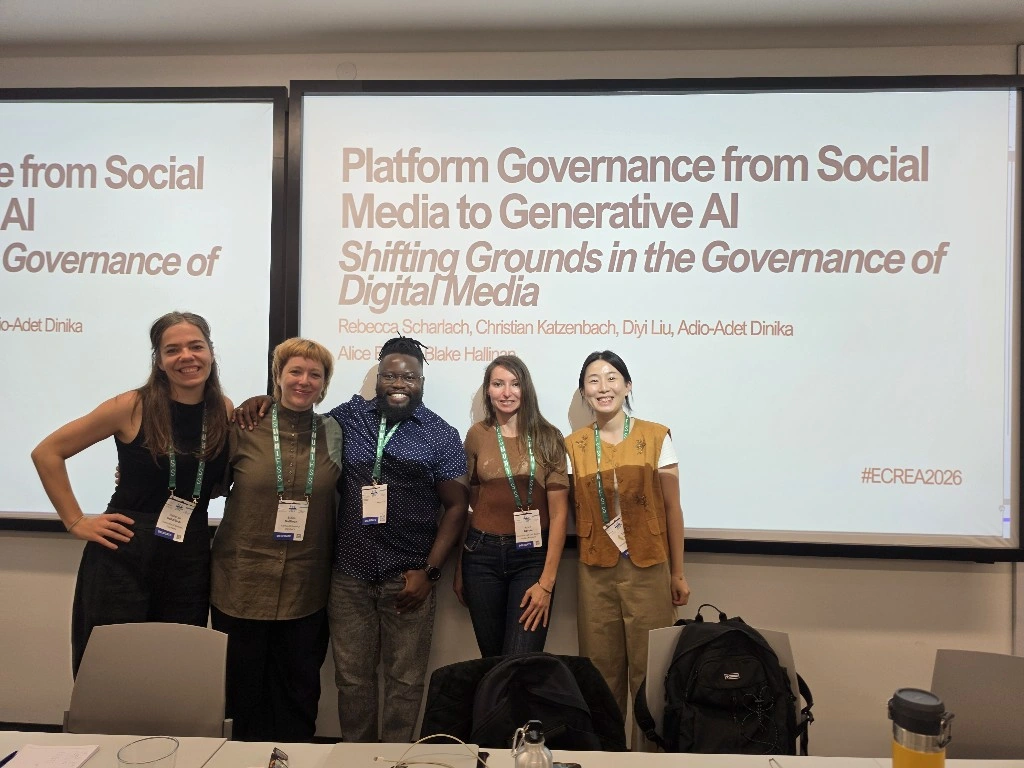
Last week we met at ECREA in Brno to discuss the shifting grounds of the governance of digital media. Speakers were Diyi Liu (CTS, University of Copenhagen), Alice Lima Baroni (University of East Anglia), Adio Adet-Dika (PGMT Lab, University of Bremen), and Blake Hallinan (Aarhus University). The roundtable was part of the Communication, Law and Policy Division and organized by Rebecca Scharlach (PMGT Lab, University of Bremen) and Christian Katzenbach (PMGT Lab, University of Bremen). Below, I will briefly outline the key discussion points for anyone interested or unable to attend.
As I prepared the introduction for the roundtable, I decided it’s best to reflect on events that unfolded over the past two-ish years within platform and AI governance (or what I (and others) simply call ‘tech governance’ for now): Trump’s reelection. The DSA and the AI Act were introduced and implemented. The Digital Omnibus. Social media bans for teenagers. TikTok 24 h ban in the US. X getting banned in multiple countries because Grok started circulating non-consensual, sexually explicit synthetic images. AI agents hacking and attacking each other. And it feels like there is a new tech scandal around the corner almost every week. TL;DR: the grounds keep shifting.
The roundtable opened with brief inputs from each speaker. Diyi focused on the political legitimacy of platforms and AI companies as they exercise power over social and political life, pointing out that we need to examine how the rules and norms governing online expression and participation are legitimized, by whom, and on what basis. Alice argued that the rapid integration of generative and especially agentic AI into online platforms threatens democratic discourse, human rights, and the trustworthiness of information ecosystems. Adio added another angle, highlighting that platform governance relies on a hidden human infrastructure of data and content workers. Through the stories of two data workers, he illustrated how the promise of automation repeatedly depends on making human layers and human labor less visible. Blake rejected the framing “from social media to generative AI,” noting that concerns of social media governance haven’t gone away. Instead, they argued, the two are enmeshed, and we should pay attention to how generative AI is reshaping existing social media governance, drawing on examples of their own work on the creator economy.
While each speaker approached the discussion from a distinct angle, the common thread centers on the expansion and contestation of content moderation. All four speakers point to a highly contested ecosystem where boundaries are blurring. They raise concerns about who holds decision-making power, and how the unprecedented speed of AI technologies is outbalancing traditional regulatory frameworks.
The roundtable continued with an open discussion with audience members urging the field to identify and address the “shifting grounds” and regulatory grey zones of tech governance. And there are many – from social media takeovers, to the spread of GenAI slop and harmful AI-generated images, to the continued spread of misinformation, to the involvement of tech CEOs in national politics, tech ideologies (a personal favorite), geopolitical pressures, to debates over the usefulness of social media bans, to data centers and how much energy and water they waste –to name a few examples. The conversation also shifted to alternative forms of accountability, focusing on the ongoing need to hold tech firms accountable amid a lack of AI regulation, alongside concerns about the Digital Omnibus and deregulation within the EU for the sake of business opportunities. We also discussed the importance of human involvement in tech governance, citing examples ranging from content moderators and creators to policy experts involved in drafting digital legislation.
Finally, the discussion turned to infrastructure, highlighting the geopolitical urgency of paying attention to what is happening around satellite-based connectivity. Audience members emphasized that the EU must invest in its own infrastructure to challenge the extreme concentration of power currently held by a limited number of private stakeholders. The conversation also touched on how regulation continues to lag behind technological development. For example, ChatGPT is only now being classified as a platform under the DSA, prompting the question of why it took so long.
We closed the roundtable by looking ahead to future research priorities. Blake, Diyi, Alice and Adio focused on innovation from smaller actors within middleware and alternative platforms; child safety, particularly in light of the current debate on social media bans across countries, with Canada’s Online Safety Act mentioned as a promising model; as well as the overlooked position of data workers in Africa affected by the development and consumption of GenAI – which is a group not yet addressed by, for example, European digital legislation.
This 90-minute discussion could easily have continued. It left me (not trying to speak for others here) with a mix of feelings: hope for the field of tech governance, urgency to keep pushing critical approaches in the midst of geopolitical crisis, and almost a nagging sense that we are behind, that there is more to be done than any of us can currently keep up with. We are seeing an enmeshment of patterns from the past, when the field was more homogeneous, with more heterogeneous developments as tech companies take on different faces and political agendas. Without wanting to sound pedantic, the roundtable was a reminder that the ground beneath us won’t stop shifting any time soon, but also brought some hope that the platform & AI governance community is prepared for these shifts.
Thanks to Sally Broughton Micova and the CLP division for making the roundtable happen, thanks to the speakers Diyi, Alice, Adio and Blake for their excellent inputs and to the great participants who decided to join the roundtable despite late afternoon and 30 degrees, it was a great discussion – hopefully to be continued.